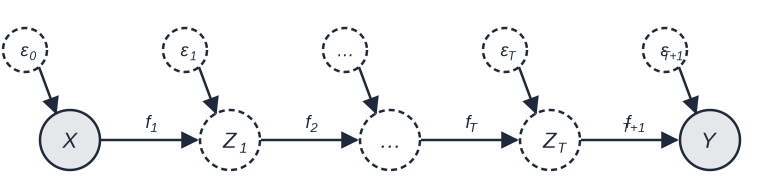
Key Idea
In an additive noise model, the effect is a function of the cause plus noise that is independent of the cause. Even if every step in a causal chain follows this model, the relationship between the observed endpoints can violate the additive noise assumption when unobserved mediators are present. BiDD fits a conditional diffusion model in each direction and measures how strongly the predicted noise depends on the conditioning variable. It favors the direction with weaker dependence.
Causal direction accuracy with one unobserved mediator
With one hidden mediator, BiDD achieves the highest average accuracy across mechanism and noise settings.
Average accuracy of each method across 7 mechanism/noise combinations (linear, neural net, quadratic, tanh; Gaussian or uniform noise), one unobserved mediator, n = 1000.
BibTeX
@inproceedings{meier2025bidd,
  title={When Additive Noise Meets Unobserved Mediators: Bivariate Denoising Diffusion for Causal Discovery},
  author={Meier, Dominik and Hiremath, Sujai and Ghosal, Promit and Gan, Kyra},
  booktitle={Advances in Neural Information Processing Systems},
  year={2025}
}